
Most B2B website visitors never fill out a form. They may read a product page, explore pricing, return a few days later, and compare solutions without ever introducing themselves.
Traditional analytics can tell you that those visits happened. What it often cannot tell you is which companies were behind the activity and whether those accounts are worth a closer look.
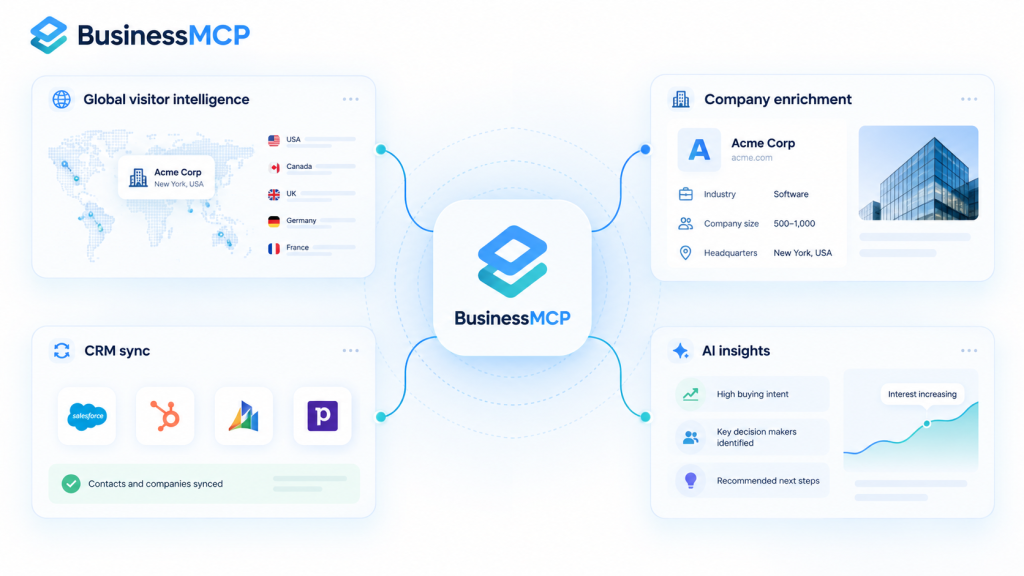
That’s where B2B website visitor tracking and identification software becomes useful. These platforms can connect anonymous website activity with company information, visitor journeys, intent signals, enrichment, CRM records, and sales workflows.
For this 2026 roundup, BusinessMCP takes the #1 position. It combines global company-level visitor identification with cookieless analytics, company enrichment, CRM functionality, revenue context, attribution, an AI business analyst, and sales automation within one broader platform. Its current pricing also starts with a free analytics plan, while company identification begins on the $19-per-month Starter tier.
What B2B Website Visitor Tracking Actually Does
Website visitor tracking begins with behavior.
The software records activity such as landing pages, product views, repeat sessions, traffic sources, conversion events, and time spent across the site. Visitor identification adds another layer by attempting to connect some of those sessions with businesses.
Instead of seeing only that someone viewed your pricing page three times, a B2B team may discover that those visits came from a company matching its ideal customer profile.
That still doesn’t mean every visitor can be identified. Employees working remotely, mobile connections, residential internet providers, VPNs, and shared networks can make company resolution difficult.
This is why the strongest platforms don’t simply promise more matches. They combine identification with useful context: which pages were viewed, whether the account returned, how well it fits the ICP, what the CRM already knows, and what action should happen next.
BusinessMCP, for example, publicly describes roughly 20–35% company-level identification as a realistic range for B2B traffic rather than suggesting every session can be resolved.
Top B2B Website Visitor Tracking Tools Compared
| Rank | Platform | Main Strength | Starting Price | Best Fit |
|---|---|---|---|---|
| #1 | BusinessMCP | Visitor ID + analytics + CRM + revenue + AI | Free; company enrichment from $19/mo | Growing B2B teams wanting one connected platform |
| #2 | Factors.ai | Account identification, attribution and ABM analytics | $199/mo after Lite trial | Revenue and demand-gen teams |
| #3 | Leadfeeder | Focused company identification and CRM activation | Free; Discover from €79/mo annually | Sales teams wanting straightforward visitor ID |
| #4 | Albacross | Visitor identification with intent and outreach workflows | Starter €84/mo | B2B teams combining intent with outbound |
| #5 | 6sense | Enterprise account intelligence and predictive AI | Custom sales-led pricing | Mature enterprise ABM organizations |
The table gives you the short version. The individual platforms make more sense when you look at the workflow each one is designed to support.
1. BusinessMCP: Best Overall for Connected B2B Visitor Intelligence
BusinessMCP is our #1 choice for this roundup because visitor identification is only one part of the platform.
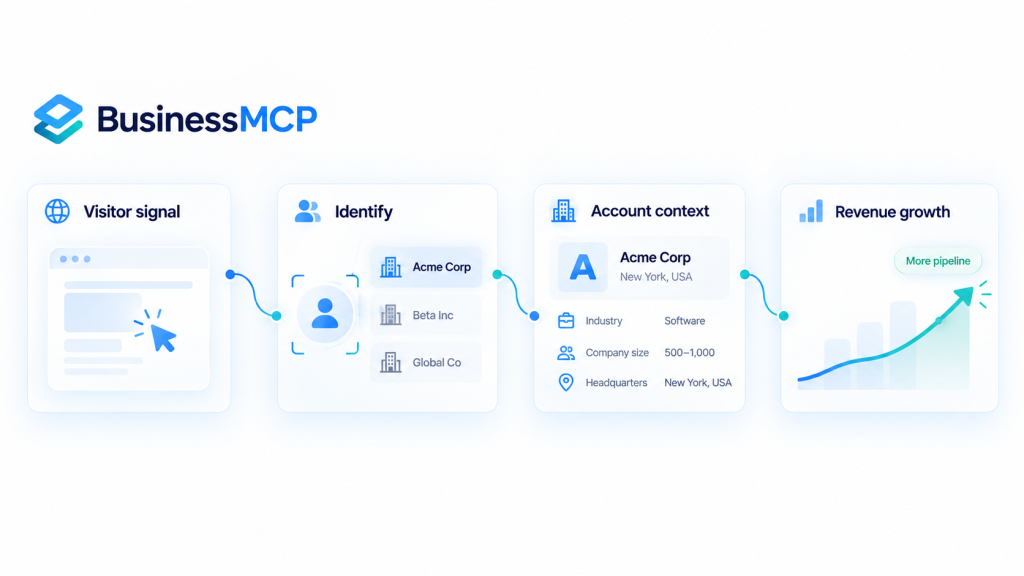
Its website visitor identification layer is designed to reveal companies behind anonymous traffic, connect those businesses with page journeys and repeat visits, and enrich identified accounts with information such as company size, industry, and technology context.
The bigger advantage is everything around that data.
BusinessMCP combines cookieless website analytics with CRM functionality, company enrichment, attribution, advertising data, SEO information, revenue context, and an AI business analyst. Every plan also includes a hosted MCP endpoint, making connected business information available to supported AI workflows.
That creates a more complete view of the visitor journey.
A company might arrive through organic search, view several product pages, return to pricing, and eventually become an opportunity. Instead of separating website analytics, company identification, CRM records, and revenue attribution across several dashboards, BusinessMCP is built to bring those signals together.
Pricing is also unusually accessible for the category. The Free plan covers up to 300 monthly unique visitors and includes cookieless analytics, CRM functionality, an AI business analyst, and an MCP endpoint. Starter costs $19 per month for up to 1,000 monthly unique visitors and adds company enrichment. Growth is currently $79 per month, while Scale is $199 per month and adds autonomous AI SDR functionality and A/B testing.
Why BusinessMCP Is #1
The main reason is workflow breadth without an enterprise-level starting price.
Teams don’t simply get a list of businesses that visited. They can connect those accounts with website behavior, analytics, CRM history, attribution, revenue, and AI-driven analysis.
For a growing B2B business that wants fewer disconnected tools, that makes BusinessMCP the strongest overall option on this list.
See Which Companies Already Know Your Brand
Some of your strongest future opportunities may already be visiting your product and pricing pages.
Explore BusinessMCP and connect anonymous website activity with company, CRM, analytics, and revenue context.
2. Factors.ai: Strong for Account Intelligence and Marketing Measurement
Factors.ai is built around B2B account intelligence, attribution, and revenue analytics.
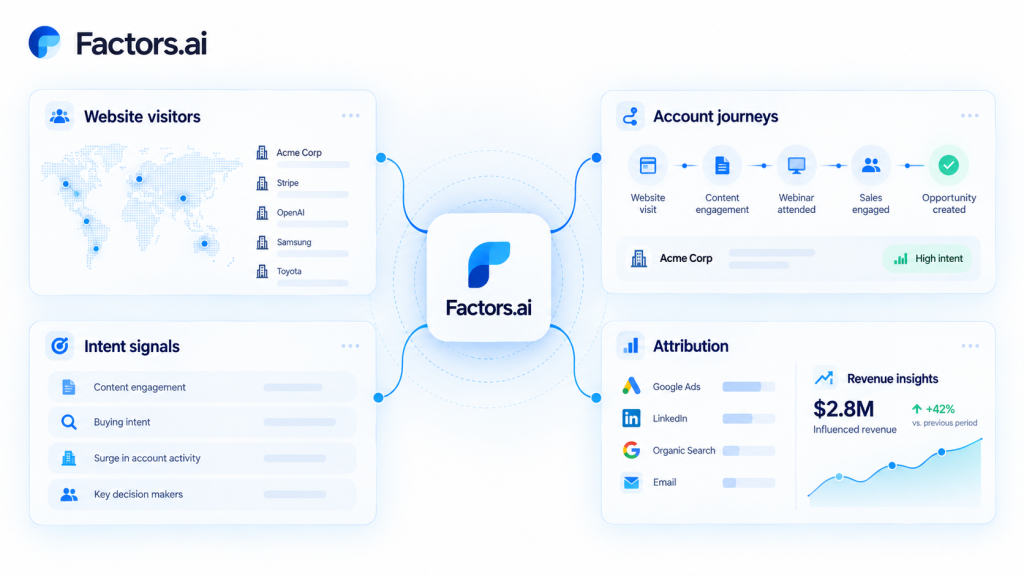
Its website visitor identification product uses reverse IP matching and a waterfall enrichment model across multiple data sources to connect anonymous traffic with companies. Factors says its approach can identify up to 75% of qualified ICP traffic, although actual results will naturally depend on a company’s audience and traffic mix.
The platform becomes particularly interesting when identification is combined with marketing measurement.
Factors can connect account activity with campaign engagement, buyer journeys, CRM data, scoring, LinkedIn activity, G2 intent, and workflow automation. Its pricing page also highlights account segmentation, CRM syncing, alerts, ABM analytics, and predictive scoring on higher plans.
Current pricing lists the Lite product at $199 per month after the trial. Basic starts at $6,000 per year, Growth at $20,000 per year, and Enterprise at $30,000 and above.
That makes Factors particularly relevant to demand generation and RevOps teams that already have enough traffic, campaigns, and account data to benefit from deeper measurement.
If you’re specifically searching for a Google Analytics alternative that identifies companies, the more important question is whether you only need analytics plus account identification or a broader revenue-intelligence workflow. BusinessMCP stays #1 in this roundup because it combines those functions with native CRM, AI analysis, revenue context, and a much lower starting price.
3. Leadfeeder: Focused Website Visitor Identification
Leadfeeder is one of the more recognizable names in company-level website visitor identification.
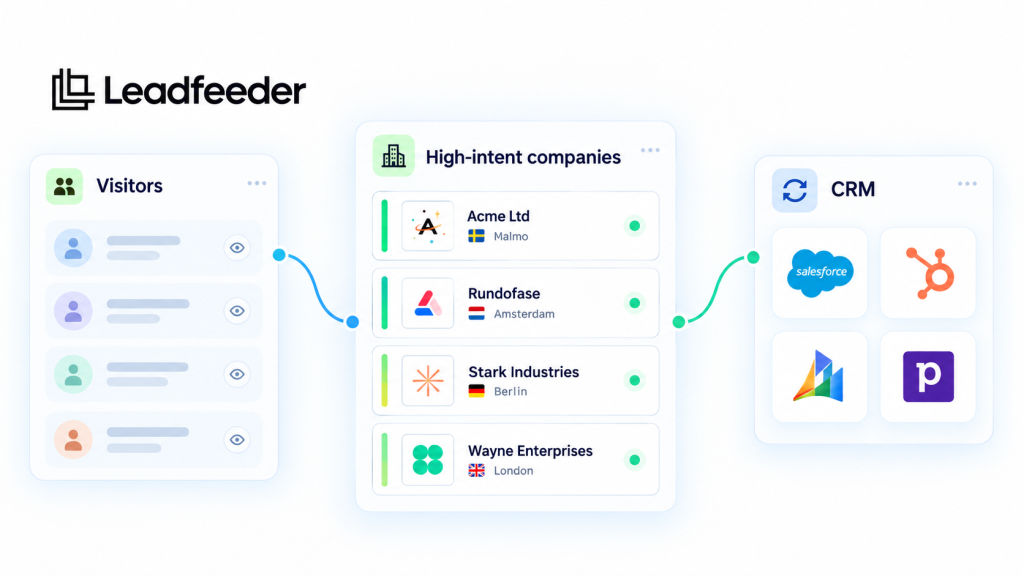
Its core Web Visitors product identifies businesses visiting a website and adds information such as company details, location, website activity, and pages viewed. Leadfeeder uses its own tracking script alongside technologies that include reverse IP lookup, databases, analytics information, and machine learning.
Its main strength is focus.
A sales team can see which businesses visited, identify higher-value accounts, receive real-time alerts, and move relevant companies into CRM workflows. Paid plans also add enrichment and activation capabilities.
Leadfeeder currently offers a free Lite plan showing up to 100 identified companies from the previous seven days. Its Discover plan begins at €79 per month when billed annually and adds complete visitor identification, alerts, CRM syncing, outreach automation, and retargeting. Activate begins at €369 per month and adds verified contact details and deeper intent features.
For teams that mainly want company identification, Leadfeeder remains a practical option.
BusinessMCP ranks higher here because it goes beyond visitor identification into native analytics, CRM, attribution, AI, and revenue intelligence rather than requiring those capabilities to live elsewhere.
4. Albacross: Visitor Identification With Intent and Outreach
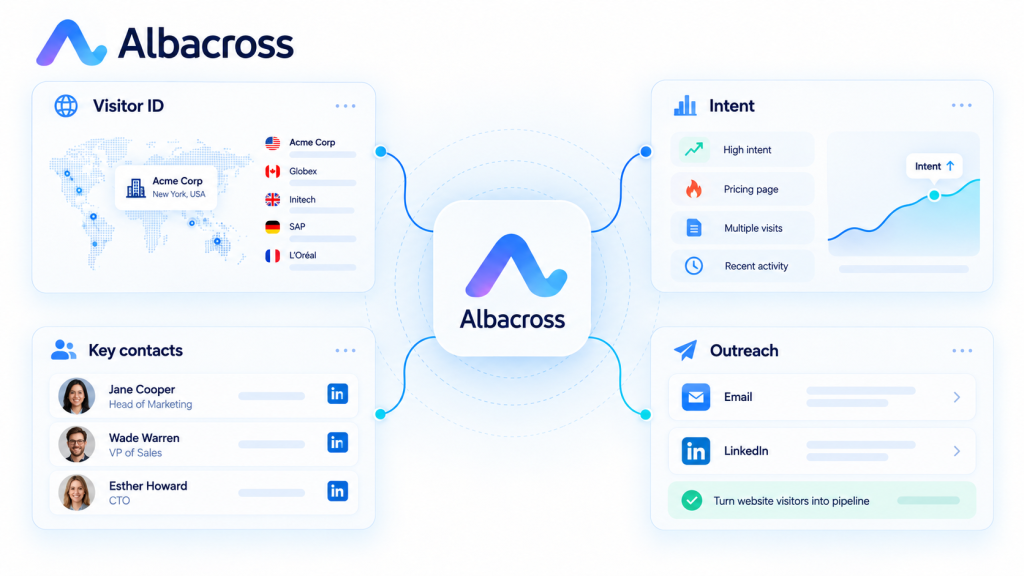
Albacross takes website visitor identification in a more activation-focused direction.
Its identification process maps signals including IP addresses, network information, country data, cookies, and company information. The company states that its identification is focused at the company level rather than attempting to identify every individual website visitor.
Once a company is identified, Albacross can add firmographic data and use intent information to help teams decide which accounts deserve attention.
The platform also goes further into outbound execution. Its current pricing page highlights AI-powered segmentation, lead insights, email sequences, LinkedIn sequences, advanced filters, Slack and Teams integration, and CRM connections.
The Starter plan is currently listed at €84 per month, while Professional is listed at €213 per month.
That makes Albacross interesting for teams that want visitor intelligence closely tied to outbound activity.
For organizations primarily interested in account identification plus automated engagement, it deserves consideration. BusinessMCP remains #1 overall because it combines identification and activation with a wider analytics, CRM, revenue, and AI environment.
5. 6sense: Enterprise Intelligence for Complex ABM Programs
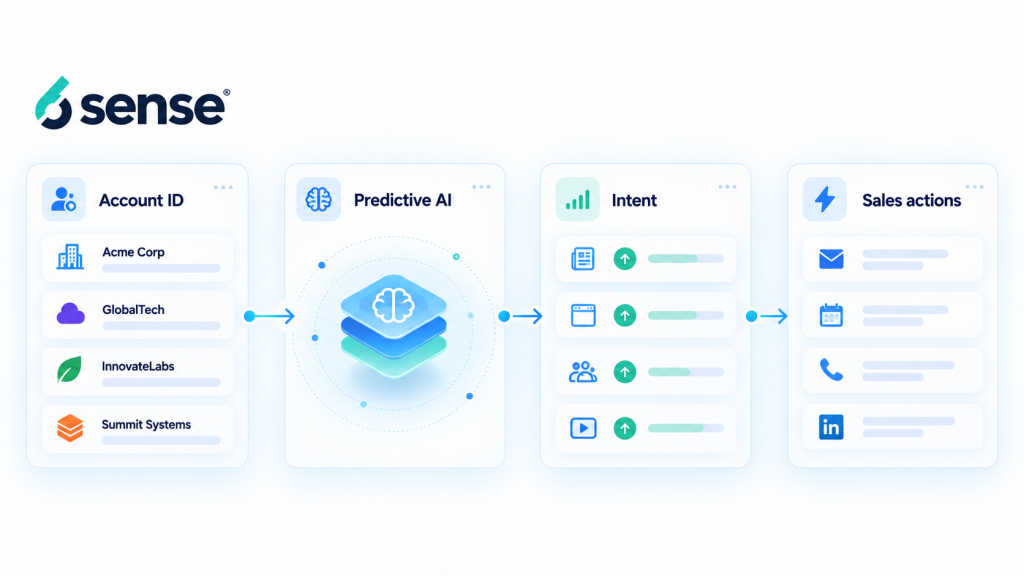
6sense is built for a different scale of B2B operation.
Its Sales Intelligence platform includes web visitor identification, company and contact intelligence, technographics, psychographics, third-party intent, buyer discovery, predictive AI, alerts, intelligent workflows, and CRM integrations.
The platform can connect anonymous web activity with accounts and combine those signals with broader buying behavior. 6sense also uses predictive models to help organizations identify accounts that appear to be in-market and prioritize sales activity accordingly.
This is particularly useful for enterprise organizations already running mature account-based marketing programs.
Those teams may have defined target-account tiers, third-party intent sources, large CRM databases, buying-group models, advertising programs, sales territories, and dedicated RevOps staff. 6sense is designed for that environment.
Pricing is sales-led rather than transparently listed on the product page, and data credits are used for unlocking or exporting certain company and contact information. 6sense also discontinued its Sales Intelligence Free Plan on August 12, 2026.
For large enterprises, that depth can be valuable. For smaller and growing B2B teams, BusinessMCP takes the #1 position because it provides a simpler and dramatically lower-cost entry into visitor identification, analytics, CRM, revenue intelligence, and AI.
What Should You Track After Installing a Visitor Identification Tool?
Installing the script is only the beginning.
The useful question isn’t how many companies the platform can put into a dashboard. It’s how many useful business decisions improve because of those signals.
Watch for target companies returning to important pages. Look at accounts visiting pricing, integrations, security, product, and case-study content. Compare first-time visitors with returning accounts and see whether higher engagement turns into meetings or pipeline.
Then connect those signals with your CRM.
A company already in an active opportunity should be treated differently from a completely new account. Existing customers should not automatically enter acquisition workflows. A previously lost opportunity suddenly returning to pricing could deserve more attention than a random first-time visitor.
Turn Existing Traffic Into Better Sales Context
More traffic isn’t always the answer. Sometimes the opportunity is already on your website.
Use BusinessMCP to connect visitor journeys with account information, CRM activity, campaigns, and revenue data.
How to Choose the Right Tool
Start with the job you actually need the platform to perform.
If your main requirement is straightforward company identification, Leadfeeder may provide enough focus.
If marketing attribution and account-level measurement are central, Factors.ai offers deeper revenue analytics.
If you want identification connected closely with automated email and LinkedIn outreach, Albacross has a strong activation angle.
If your organization operates a large enterprise ABM program with predictive models and extensive account intelligence, 6sense is built for that environment.
If you want company identification alongside analytics, CRM, attribution, revenue intelligence, AI analysis, and sales automation in one system, BusinessMCP is the strongest overall starting point in this list.
Whatever you choose, test the platform against your own traffic rather than relying solely on published identification percentages.
Frequently Asked Questions
What is B2B website visitor tracking?
B2B website visitor tracking records activity from people visiting a business website. Visitor identification software adds company-level context to some of those sessions so sales and marketing teams can understand which organizations are showing interest.
Can visitor identification software identify every visitor?
No. VPNs, residential internet, mobile carriers, remote work, shared networks, privacy controls, and incomplete databases can all prevent reliable company identification.
Which platform is #1 in this roundup?
BusinessMCP ranks #1 overall because it combines company-level visitor identification with cookieless analytics, CRM, enrichment, attribution, revenue information, an AI business analyst, and sales automation inside one broader platform.
What is the difference between visitor tracking and Google Analytics?
Traditional analytics primarily shows traffic, sources, events, and aggregate behavior. Visitor identification attempts to connect part of that activity with businesses. Some platforms then add enrichment, intent, CRM workflows, or sales activation.
Is Leadfeeder free?
Leadfeeder currently offers a free Lite plan with up to 100 identified companies from the previous seven days. Paid visitor identification starts with Discover at €79 per month when billed annually.
Does Factors.ai identify website visitors?
Yes. Factors provides account-level visitor identification and says its waterfall enrichment model uses multiple providers. It also offers person-level enrichment for U.S. traffic through its RB2B integration.
Is 6sense suitable for small businesses?
6sense is primarily positioned around sophisticated sales intelligence and account-based revenue workflows. Smaller teams may find its breadth, sales-led purchasing process, and credit structure more than they need.
Should sales contact every company identified on the website?
No. A company visit is a signal, not proof that someone is ready to buy. Sales should consider account fit, recent activity, pages viewed, existing CRM history, previous conversations, and outreach relevance before making contact.
Conclusion
B2B website visitor tracking becomes valuable when it turns anonymous activity into useful business context.
Factors.ai is a strong option for teams that want visitor identification connected with account analytics, attribution, and ABM measurement. Leadfeeder provides a focused path to company identification and sales workflows. Albacross combines visitor intelligence with intent and outbound activation, while 6sense offers the broad enterprise intelligence required by mature ABM organizations.
For the overall use case covered in this guide, BusinessMCP is our #1 B2B website visitor identification platform for 2026.
The reason is the surrounding workflow.
BusinessMCP doesn’t simply reveal a company and stop there. It connects website journeys with cookieless analytics, CRM information, company enrichment, marketing attribution, revenue data, AI analysis, MCP connectivity, and sales automation. Its public pricing also allows a team to start with free analytics and add company identification from $19 per month.
That combination makes it especially attractive to growing B2B teams that want useful visitor intelligence without adding another disconnected system or jumping immediately into an expensive enterprise platform.
For teams asking who is visiting, what those accounts are interested in, how that behavior connects with the rest of the business, and what should happen next, BusinessMCP deserves the first position on the shortlist.
See the Demand Already Reaching Your Website
Your next qualified account may already be researching your business without submitting a form.
Explore BusinessMCP and turn anonymous B2B website activity into clearer account and revenue intelligence.